Iceland rewards the unhurried. Not just because the landscapes are better when you stop to look at them (though they are), but because the country has a habit of making you pull over when you hadn't planned to.
The Golden Circle
The Golden Circle is what most people mean when they say they've done Iceland. It is a roughly 300-kilometre loop from Reykjavik, connecting the anchor points of Þingvellir, Geysir, and Gullfoss, and it earns its status as the country's most-visited route not through marketing but through sheer geological and historical density. You can drive it in a day. Two is better.
Start in Reykjavik itself, and start earlier than you think necessary. The old town (the streets around Aðalstræti, the city's oldest) is compact and walkable. Reykjavik is a capital of 130,000 people in a country of 370,000, and it carries that quality unique to small capitals: a sense that everyone responsible for running the place is within walking distance of where you're having coffee. The National Museum of Iceland covers settlement through the present day and gives the rest of the trip a frame. The Settlement Exhibition, built around the excavated remains of a Viking longhouse dating to the late ninth century, is built directly into the ground beneath downtown; you walk across glass floors and look down at the actual wall foundations. These are the remains of the first settlement here, and they are worth slowing down for.
The man credited with that first settlement is Ingólfr Arnarson, a Norwegian chieftain who arrived on Iceland's southwest coast around 874 AD. The sagas tell it this way: as he approached land, he threw his high-seat pillars (the carved wooden posts from his Norwegian hall, the symbolic heart of a Norse home) overboard into the sea, and swore to settle wherever the gods washed them ashore. It took three years to find them. They had drifted into a bay thick with steam rising from the geothermal ground. He called the place Reykjavík: Smoky Bay. The longhouse the Settlement Exhibition is built around almost certainly belonged to one of his earliest followers, constructed on the same site within a generation of that landing.
Picture what this place looked like then. Iceland in the ninth century was more forested than it is today; birch trees covered perhaps a quarter of the land before the settlers cleared them for timber and pasture. The settlement at Reykjavik would have been a single turf longhouse, perhaps thirty metres long, its walls made of stacked sod a metre thick to hold out the cold, its roof covered in the same. Inside: a long central hearth, sleeping benches along the walls, livestock sheltered at one end during winter. Beyond it, a few smaller outbuildings. The population of the entire site was probably two or three dozen people. The bay would have been silent except for geese and the sound of the sea. The steam rose from the ground exactly as it does now.
Hallgrímskirkja, the Lutheran church that dominates the modern skyline, was designed in 1937 and completed in 1986. Its stepped concrete tower was modelled on the basalt columns you'll see later at the black sand beaches (a deliberate echo of the geology that defines the island). In front of it stands a statue of Leifur Eiríksson, gifted by the United States in 1930. Leif was the son of Eiríkr rauði (Erik the Red), who had himself been exiled from Iceland for manslaughter and sailed west to discover Greenland, where he founded the first Norse colony around 985 AD. Leif went further. Around 1000 AD, following the account of a merchant who had spotted unknown land to the west, he sailed to a place the sagas call Vinland. He reached North America five centuries before Columbus. The statue outside Hallgrímskirkja shows him with his hand raised, looking west (the only direction that makes sense, when you know the story). The street leading up to the church (Skólavörðustígur) is painted in rainbow stripes, lined with independent bookshops, coffee bars, and concept stores. It serves as a corridor of conspicuously modern Reykjavik, funnelling you toward a building that looks like it was carved from the earth itself. Stop by Kafe Loki to grab some rye bread ice cream and enjoy the little boutique shops. The juxtaposition witnessed is not accidental; Reykjavik is a place, nowadays, that wears its Viking bones lightly, but whose spirit lives in the modern era.
The drive east from Reykjavik takes you through lava fields that are simultaneously lunar and alive; mosses cover everything, the only plants stubborn enough to colonise fresh basalt. Þingvellir National Park appears after roughly an hour, and it demands a stop. The Alþingi (the Icelandic parliament) was founded at Þingvellir in 930 AD, making it one of the world's oldest existing parliamentary institutions. The chieftains of the island gathered here annually in the open air, on the rift valley floor, to resolve disputes and make law. No building, no throne; just men standing on rock, arguing. Iceland converted to Christianity at Þingvellir in the year 1000, a decision reached by vote. The rift itself is the visible boundary between the North American and Eurasian tectonic plates, still pulling apart at roughly two centimetres per year. You can stand in the gap between two continents and feel, for a moment, the scale of things.
The southwest is quietly one of Iceland's great waterfall regions, and the Golden Circle puts several of the best within easy reach. Gullfoss (Golden Falls) sits at the end of the loop: a double-tiered cascade where the Hvítá river drops 32 metres into a gorge and disappears from view, the mist catching the light on clear days in a way that explains the name. A short detour off the main route brings you to Brúarfoss, a waterfall so intensely blue it looks artificially coloured; the hue comes from glacial meltwater passing through ancient lava fields, filtering it to an almost impossible clarity. Faxi, also known as Vatnsleysufoss, is gentler and wider, a broad curtain of water stretching nearly 80 metres across the Hvítá before the same river narrows again downstream. These are not the dramatic plunges of the south coast; they are quieter, more varied, each shaped differently by the terrain that made them. The south coast's bigger falls, Seljalandsfoss and Skógafoss, wait further along the Ring Road, but the southwest makes a strong argument that Iceland does not save its best for last.
The Ring Road: South and East
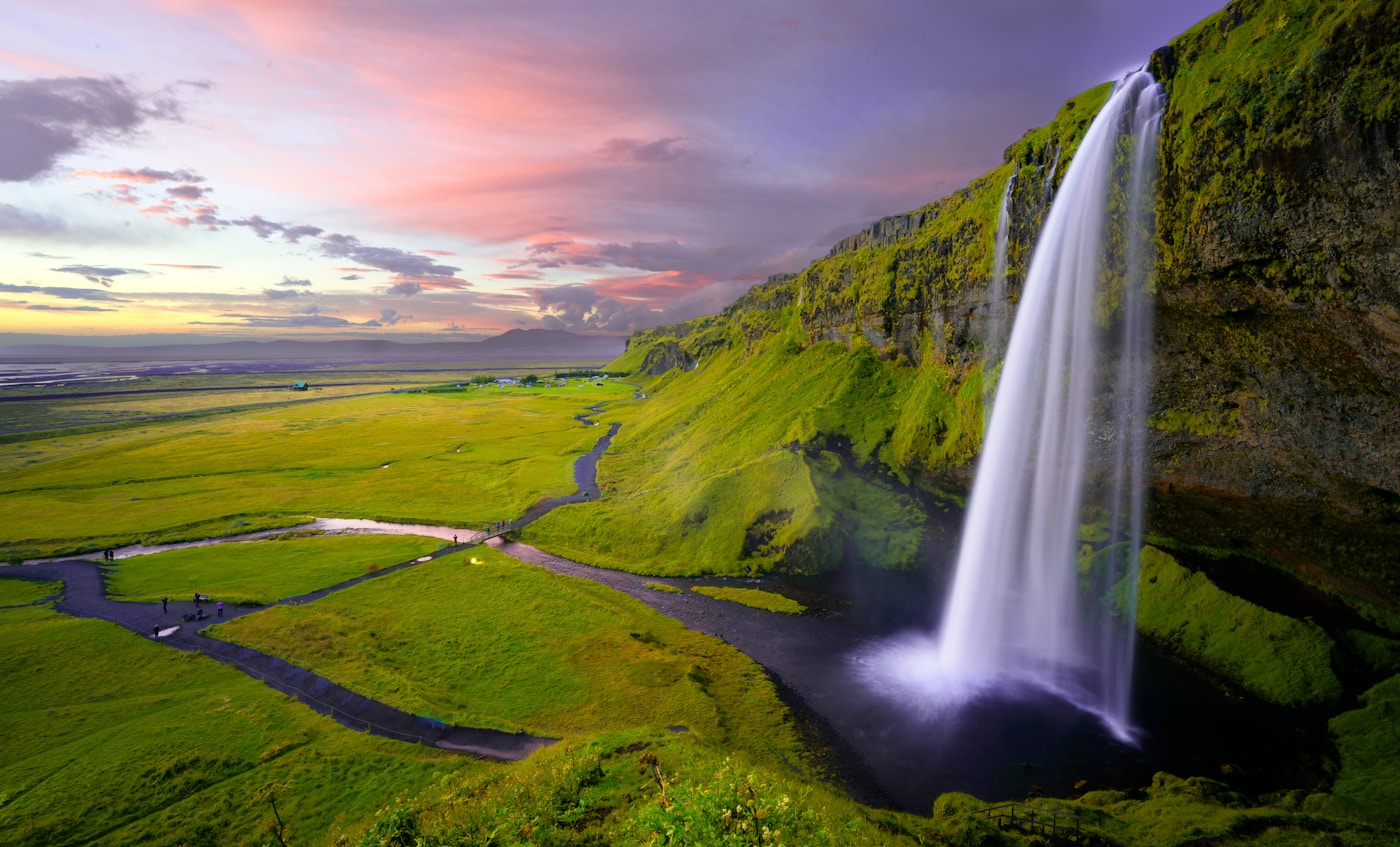
Route 1 circumnavigates the entire country, and the southern stretch is where Iceland becomes the Iceland of photographs. The waterfalls come first. Seljalandsfoss allows you to walk behind the curtain of water (it sounds like a gimmick until you're standing inside it); looking out at a green Icelandic valley through a moving wall of white. Skógafoss, a few kilometres east, falls 60 metres straight down and generates so much mist that the surrounding hillside is permanently lush.
Then the landscape shifts. The vegetation thins. The black sand begins.
Reynisfjara, the black sand beach outside Vík, is one of those places that makes you feel the planet's indifference acutely. The sand is ground basalt (volcanic, dark, and fine) and the Atlantic waves that arrive from the west have been coming, uninterrupted, since the last ice age. The basalt sea stacks offshore are called Reynisdrangar; in Icelandic folklore, they are trolls caught by sunrise and turned to stone. The sneaker waves here are serious and the warning signs are not decorative. The beach is beautiful in the way that cold, violent things are beautiful.
East of Vík, the road crosses the Eldhraun lava field (565 square kilometres laid down in the 1783 Laki eruption), which killed a fifth of Iceland's population through famine and volcanic gases and cooled temperatures across Europe for years afterward. The lava is now covered in moss so thick it looks like carpet. The highway cuts through it for miles with nothing to indicate how recently, in geological terms, all of this was molten.
The glacier lagoon at Jökulsárlón sits at the edge of Vatnajökull, Europe's largest glacier by volume. Icebergs calve from the glacier and drift slowly through the lagoon toward the sea; some blue, some white, some striped with ash from old eruptions. Diamond Beach, just across the road, is where smaller chunks wash ashore on black sand and catch the light. The effect is exactly what it sounds like, and no photograph quite accounts for the silence.
From Jökulsárlón, the road climbs into the Eastern Fjords; a series of long, narrow inlets where the mountains drop almost vertically into the sea. The towns here are small and self-contained: Höfn, known for its langoustine; Fáskrúðsfjörður, which has bilingual signs in Icelandic and French, a remnant of the fishing fleets that wintered here for decades; Seyðisfjörður, reached by a switchback road over a mountain pass, a town of painted wooden houses and waterfalls that feels as though the rest of the world simply hasn't found it yet.
The fjords are quiet in a way that feels earned. By the time you reach them, you've driven through geothermal fields, across recent lava, past glaciers that are visibly retreating. Iceland does not let you forget that it is still being made. For those willing to go further, the F-Roads (the interior highland tracks marked with an F on Icelandic maps) branch off into terrain that makes the Ring Road feel suburban: unbridged river crossings, raw volcanic desert, routes that are impassable for most of the year and open only in summer, strictly for high-clearance four-wheel-drive vehicles. They are not for the unprepared, but they reach parts of Iceland that the paved roads never touch. The eastern fjords are the oldest part of the island (the first land to stop moving) and even there, on a clear evening, the mountains reflect in the water and you can see exactly how the whole extraordinary thing began.